New paper on hydrologic feedbacks in the Everglades has been published in PLoS One.  In this study, we develop a mathematical model of interactions between peat accumulation, vegetation productivity, soil elevation, and water flow.  We show that the resulting feedbacks can cause spontaneous divergence of ridges and sloughs, and that these feedbacks act differentially with direction.  The model provides a range of predictions that we are hoping to test with data from our Everglades monitoring project.  You can download the paper here.
 
 
In between collecting data and writing papers, we do have to eat.  Happily, Durham is a great place to do that.  There are lots of really creative and exciting restaurants ranging from the casual to the refined, many of them with a focus on updating southern cuisine.  We have a great farmer's market, and many restaurants place a lot of emphasis on local sourcing of there food.  A fleet of food trucks peddle everything from dumplings to pizza to raw foods.  No wonder Durham was recently named Tastiest Town by Southern Living magazine!
 
 
Picture
Tim Covino, along with McGlynn Lab grad students Kendra Kaiser and Erin Seybold, organized a demonstration day at our field site in New Hope Creek.  The New Hope Creek project involves continuous monitoring of water chemistry and other variables to understand processes going in the terrestrial watershed and within the stream itself.  Tim, Kendra, and Erin, along with many other members of the River Center, took this opportunity to educate members of the community about the things we measure, how we measure them, and why.  

Picture
Kris Voss of the Bernhardt lab helped find and identify stream invertebrates.

Picture
As you can see, the recent rains had NHC running pretty high and turbid. One of the things we are hopnig to understand at NHC is how these floods influence metabolic processes and nutrient cycling.


Chelsea Clifford has accepted an offer to enter the PhD program at the Nicholas School as a member of the Heffernan lab.  Chelsea is a graduate of Carleton College, has worked on Chesapeake Bay restoration and land use effects in central Florida, and is the recipient of a National Science Foundation Graduate Research Fellowship. Congratulations Chelsea, and welcome to Duke, the River Center, and the Heffernan Lab!
 
 
Our paper on ecohydrologic feedbacks and pattern formation has just been accepted for publication in PLoS One.  This paper uses a simple quasi-spatial model to show that the need to route water through the Everglades landscape, in conjunction with local positive feedbacks on peat accretion, can produce directional feedbacks that generate flow-perpendicular pattern.  The model also makes a number of predictions about relationships between water flow and microtopographic variation that we hope to test with our large-scale Everglades field sampling.  Will post a link to the paper as soon as it is in press.
 
 
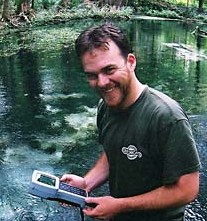
A cool set of underwater photographs of rivers from National Geographic.  One of our study sites (Blue Hole Spring in the Ichetucknee River, FL) is included.

I will note that Blue Hole has fairly high nitrate concentrations, despite it's otherwise excellent condition.  Which is an example of why we think that nitrate contamination may not be the whole story in Florida Springs.
 
 
Anna Braswell, PhD student in the lab, has received a grant from the Garden Club of America to support her research on land use history and the structure and resilience of coastal wetlands.  Way to go Anna!
 
 
Virtually everyone who submits papers for publication in peer reviewed journals will have some of those papers rejected.  This is particularly true if you are submitting work to prominent journals, so developing a thick(er) skin is essential for a life in research.  Early in my career, rejection was really hard to deal with. Since I didn't have a record or experience to fall back on, it felt as if any rejection was a step backwards professionally. Rejection of my work also stung personally.  I worked hard on that! How can these reviewers and editors think I am not good enough?

As I have advanced in my career, it is easier to recognize rejection (or acceptance) of a specific paper as a judgement on that piece of work, rather than on me personally.  A recent review request really brought this home to me. The editor who requested the review from me had recently handled a paper I submitted to the same journal, and ultimately rejected it. (After submitting to another journal, that paper is now in revision, and I hope and expect will be accepted there.) The paper I reviewed was on a related topic and had some interesting ideas, but ultimately had some substantial flaws and I recommended it not be accepted.  In his letter to the authors, the editor referred to both reviewers as experts in the subject of the paper.  So despite having recently rejected my work, this editor nonetheless sought out my opinion on a closely related paper.  If his rejection of my paper had
 
 
Our new book chapter on Sustainability and Biodiversity has just been published in the 2nd Edition of Simon Levin's Encyclopedia of Biodiversity.  This paper emerged from an NCEAS Distributed Graduate Seminar that students and I participated in while I was at Florida International University.   The chapter is aimed at a sophisticated lay audience, and discusses various definitions and components of sustainability and their relationship to and dependence on biodiversity.  I can't link to the specific article, but you can obtain one by contacting me directly.
 

Academic geneology

02/26/2013

 
Relationships between young scientists (undergraduate and graduate students, post-docs, even junior faculty) and their mentors are complicated and varied, in terms of how and how well they work, how influential a particular relationship is on one's career, and in countless other ways.  But most of us are deeply shaped by the people who help us mature as scientists.  The particular importance of one's PhD advisor is reflected in large and small ways.  One example is that NSF considers students and their PhD advisors to be in life-long conflict of interest, which means that I can never review one of my advisor's or students' grants.  Another indicator how important these relationships are is the interest of scientists (and other scholars) in their academic geneology, or who begat whom.  I recently kick-started documentation of my own academic family, which you can see here.  I am hoping that my friends and colleagues will be able to help build this into a reliable database on the academic history of limnology.

The danger of delving into academic lineages is that can (and sometimes does) reinforce insider-ism, distinguishing those with and without prominent scientists in their academic roots. One might certainly object to delving into history because of this possibility.  Can't we just measure contemporary scientists by the novelty and rigor of the work they do?  Vanity aside, is there a good reason to think about these things?  

While it would be dishonest of me to deny any pride in my own academic heritage, which includes some very prominent scientists, I think the answer to the latter question is, Yes.  Academic lineages help us remember that we are all of us standing on the shoulders of giants.  They remind us that many ideas and approaches are old, and that the history of ideas, and the people who developed and evaluated them, continue to shape contemporary science.  And they help us understand where whole disciplines and strains of thought arise.  After all, 100 years ago ecology was barely a scientific discipline.  Who were the (then mostly) men who shaped the application of scientific rigor to the study of natural history?  Some lineages in ecology trace back to early physiologists, chemists, even theologians.  How often do cross-overs occur in more recent times?  With the present emphasis on interdisciplinarity, isn't this something we want to know more about?

So while it is crucially important to separate our assessment of scientists from assessments of their academic lineages, it is also essential to our understanding of how science and mentorship work to understand the basic facts of our own academic history.